A pot of water that seems to boil almost before you’ve finished chopping the vegetables can feel like a kitchen trick. It isn’t. A well-designed induction stove sends energy directly into compatible cookware, giving you rapid heat, precise control, and a cooking surface that generally stays cooler than a traditional burner.
That speed gets attention, but the buying decision is more complicated than a quick boil test. You need to know whether your pans will work, whether your electrical panel can support the appliance, how the controls feel, and whether a full-size range or separate cooktop suits your kitchen.
This guide is for U.S. homeowners, renters, serious home cooks, and renovators comparing induction stoves with gas or a conventional electric stove. It explains the technology in plain language, covers installation and daily use, and helps you judge whether the upgrade fits your budget and cooking habits.
What Is Induction Cooking and How Does It Work?
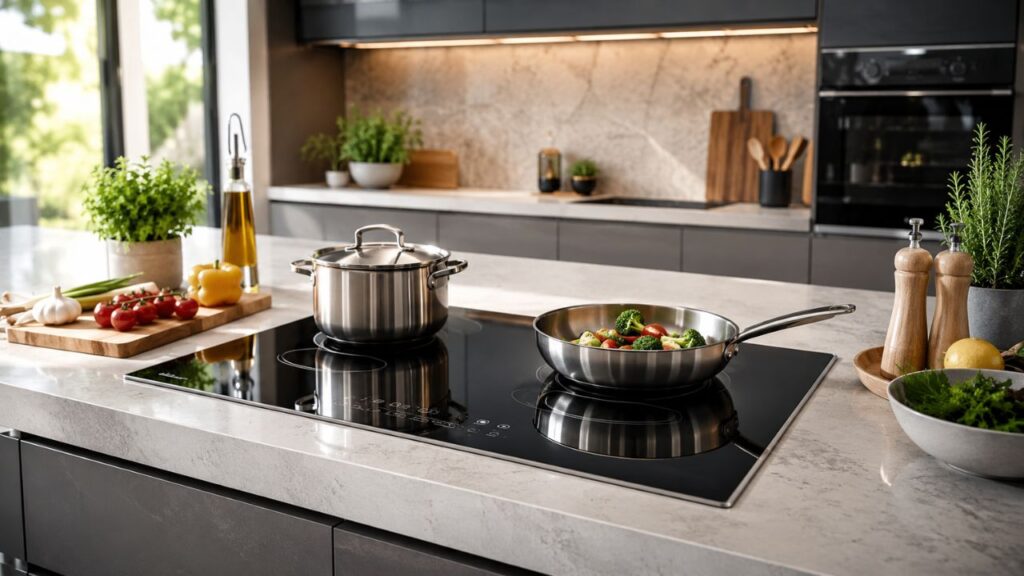
People often ask what is induction cooking because the smooth glass surface looks almost identical to a radiant electric cooktop. The difference is underneath. A coil below the glass creates a rapidly changing electromagnetic field, and compatible cookware converts that energy into heat within the pan itself.
That distinction matters. With a traditional burner, the element heats first, then the glass or grate, and finally the pan. With induction cooking, the cookware becomes the main heat source, so less energy is lost while moving through several layers.
ENERGY STAR describes residential induction technology as transferring roughly 85 percent of its energy into the cookware, compared with approximately 75 to 80 percent for conventional resistance cooking in its published educational material. Actual household energy use still depends on cookware size, cooking duration, power settings, and how often you use the oven.
What Is Induction Cooktop Technology in Practical Terms?
The question what is induction cooktop technology really means for daily cooking is simple: the burner responds quickly because it isn’t waiting for a metal coil or ceramic surface to warm up. Lower the power and the heat in the pan drops almost immediately. Raise it and you can bring water back to a boil without a long delay.
Why the Pan Matters
The magnetic field needs cookware with ferromagnetic material, meaning a metal that reacts strongly to a magnet. Cast iron, enameled iron, carbon steel, and many stainless-steel pans work well. Pure aluminum, glass, ceramic, and copper generally need a bonded magnetic base before the appliance can detect them.
A refrigerator magnet offers a useful first check. If it grips the bottom firmly, the pan will usually work, although a flat, substantial base tends to heat more evenly than a thin or warped one.
Induction Stove vs. Electric Stove and Gas Cooking
An induction stove is electrically powered, but it doesn’t cook the same way as a conventional electric stove. Radiant and coil models create resistance heat in an element, while induction uses electromagnetic energy to excite the pan. Gas burns fuel beneath the cookware and releases heat around it.
Heat Response and Precision
A quality induction range can move from a vigorous boil to a gentle simmer quickly. That responsiveness is useful for milk, chocolate, custards, sauces, and anything that scorches when residual heat remains high.
A radiant surface responds more slowly because the element and glass retain heat. Experienced cooks adapt, but they often move the pan off the burner to stop cooking. Gas responds quickly at the flame, although low-end burners may struggle to maintain a very small, stable flame.
Kitchen Comfort and Cleanup
Because more energy reaches the pan, induction usually adds less stray heat to the kitchen. That difference is noticeable during summer or in compact homes where the cooktop sits close to the dining area.
Noise and Feel
Induction isn’t silent. You may hear a fan, a faint hum, clicking, or buzzing, particularly at high power. Lightweight pans and layered cookware can make the sound more noticeable.
Benefits and Tradeoffs of an Induction Stove
The strongest case for induction cooking is control. For shoppers asking what is induction cooking compared with radiant heat, the practical difference is how quickly the pan reacts to a change in power. Fast heating shortens repetitive tasks, while fine power adjustment helps you hold a sauce below a boil or keep oil at a steadier temperature. ENERGY STAR also notes that induction can boil water faster than other common household cooking technologies under test conditions.
Safety is another advantage, but it should be described accurately. The appliance typically detects whether suitable cookware is present and stops delivering energy when the pan is removed. The glass can still be hot from the pan, hot oil can still cause burns, and unattended cooking still creates fire risk.
The Main Advantages
- Fast heat-up and strong boiling performance
- Responsive changes when you adjust power
- Less wasted heat around the cookware
- Flat surfaces that are easier to wipe
- No combustion at the cooktop
- Useful features such as timers, pan detection, bridge zones, and power boost
The Main Drawbacks
Many induction stoves cost more than basic radiant models, and electrical work may add to the project. You may need new pans, especially if your collection is mostly aluminum or copper without a magnetic base.
Is the Surface Safer Around Children?
The lack of an open flame and automatic pan detection can reduce certain risks, but child locks and supervision still matter. Residual-heat indicators should be treated seriously because the glass directly beneath a hot skillet may remain dangerous after cooking.
Choosing an Induction Range, Cooktop, or Hot Plate
A full induction range combines the cooking surface and oven in one appliance. A built-in cooktop sits in the counter above cabinetry or a compatible wall oven. A portable hot plate provides one or two zones and plugs into an appropriate receptacle.
Your kitchen layout usually narrows the choice. A full-size induction stove suits a permanent kitchen, while portable induction stoves are better for testing, rentals, and occasional extra capacity. Replacing a standard 30-inch range is often simpler than redesigning counters for a separate cooktop, while a major renovation gives you more freedom.
When a Full Range Makes Sense
Choose a range when you want one coordinated appliance and a familiar footprint. It’s often the most straightforward replacement for an existing 30-inch unit, provided the electrical connection, clearances, anti-tip protection, and surrounding cabinetry meet the new model’s instructions.
Compare oven capacity, rack design, convection modes, control placement, and service access—not just the cooktop. The oven affects daily satisfaction as much as the magnetic elements do.
When a Built-In Cooktop Is Better
A separate cooktop works well when you want wall ovens at a comfortable height or need a wider 36-inch cooking surface. It can also create storage directly below, although drawer depth may be limited by the appliance and required clearances.
When a Portable Hot Plate Is Useful
A portable hot plate is a practical way to test the technology before remodeling. It also adds capacity during holidays, keeps cooking heat out of a small kitchen, or serves an apartment where replacing the installed appliance isn’t possible.
Check wattage and circuit loading. A high-powered portable unit can draw much of the capacity of a standard 120-volt branch circuit, so avoid sharing it with other heavy appliances on the same circuit. Place it on a stable, heat-resistant surface with open ventilation around the unit.
What Is Induction Cooktop Buying Advice for Small Spaces?
For an RV, studio, basement kitchenette, or accessory dwelling unit, asking what is induction cooktop equipment appropriate for the space means looking beyond width. Consider available amperage, cord placement, ventilation, storage, and whether you need one large zone or two smaller ones.
A single-zone unit may be more useful than a cramped double model if you cook with a Dutch oven or wide skillet. Measure the pan-support area, not just the appliance body.
Cookware Compatibility and Better Daily Technique
Before buying, test every pan you use regularly. The magnet check is quick, but it isn’t the whole story. A pan can be magnetic and still perform poorly if its base is severely warped, too small for the cooking zone, or made from layers that produce excessive buzzing.
Most cast-iron and carbon-steel cookware works, as do many stainless-steel sets. Consumer Reports has noted that copper and aluminum cookware may or may not work depending on whether the manufacturer added an induction-compatible layer.
What Is Induction Cooking Like With Cast Iron?
When someone asks what is induction cooking like with cast iron, the answer is powerful but slightly less nimble than with lighter cookware. The pan responds to the magnetic field, yet its own mass stores heat. Lowering the power helps, but the skillet won’t cool instantly.
Lift heavy cast iron rather than sliding it across the glass. A clean, smooth pan bottom reduces scratching, and gradual preheating helps protect enamel and food from thermal shock.
Match the Pan to the Zone
Cookware should cover enough of the marked zone for reliable detection. A tiny saucepan on a large element may not register, while a wide pan on a small element can heat unevenly around the edges.
Center the pan before selecting power. On flexible or bridge zones, follow the manual’s guidance for griddles and long cookware rather than assuming the entire glass area heats uniformly.
Start Lower Than You Expect
People moving from gas often turn the control too high because they’re used to heat escaping around the pan. With this technology, high settings can boil over or scorch food quickly.
For eggs, sauces, and sautéing, begin in the middle of the power range and adjust upward. Reserve boost mode for water or another task the manual specifically allows, and don’t use maximum power to preheat an empty nonstick pan.
Can You Use a Converter Disk?
A magnetic converter disk lets some noncompatible cookware sit above an induction zone, but it sacrifices part of the speed and efficiency. The disk heats first and then transfers heat into the pan, making the setup behave more like a traditional electric stove.
Induction Stove Electrical, Ventilation, and Installation Requirements
Most full-size models need a dedicated 240-volt circuit, but amperage, wiring method, cord type, and breaker size vary by appliance. Always use the installation manual for the exact model and have a licensed electrician evaluate the circuit when you’re converting from gas or an older appliance.
A modern induction stove can expose limitations that weren’t obvious before, including a full panel, undersized service, aluminum branch wiring, an inconvenient receptacle, or insufficient clearance behind the unit. Discovering those issues before delivery prevents an expensive appliance from sitting unusable in the kitchen.
Check the Electrical Panel First
Ask an electrician to confirm available panel capacity, breaker space, conductor size, grounding, receptacle condition, and local code requirements. A dedicated circuit may be inexpensive when the panel is nearby and accessible, but long cable runs, finished walls, permits, or a service upgrade can change the cost substantially.
Model-specific instructions take priority over general advice. Manufacturers such as GE and Bosch direct buyers to the appliance rating information and installation documents for exact electrical requirements.
Does Induction Need Ventilation?
Yes. Although there’s no flame at the cooktop, cooking still creates steam, grease particles, smoke, and odors. Frying bacon on induction produces the same food-related pollutants as frying it over another heat source.
Use a range hood that exhausts outdoors when possible, size it appropriately for the cooking surface, and operate it during high-moisture or high-smoke tasks. An induction appliance can improve indoor air conditions compared with gas combustion, but it doesn’t eliminate the need to manage cooking emissions.
Delivery and Fit Checks
Measure the opening at several points, including the narrowest width, counter height, cabinet depth, backsplash projection, and path from the exterior door. Confirm whether the unit is freestanding, front-control, or slide-in because side panels and countertop overlap differ.
If you’re replacing gas, hire a qualified professional to disconnect and cap the fuel line according to local requirements. Don’t bury the capped connection where it can’t be inspected or serviced.
Evaluating a Bosch Induction Range and Competing Models
A Bosch induction range often appears on shortlists because Bosch sells slide-in induction models in its U.S. range lineup and emphasizes precise temperature settings, fast cooking, and coordinated European-style design. That doesn’t make one brand automatically right for every kitchen.
Treat each induction stove as a complete cooking system, then start with fit and service. Check the exact dimensions, electrical specification, oven capacity, control layout, warranty terms, and availability of authorized technicians in your ZIP code. A premium appliance is less appealing when the nearest qualified service company is several hours away.
Compare Features You’ll Actually Use
Bridge zones help when you regularly use a griddle. A warming drawer matters if you entertain. Telescopic racks can make heavy cookware easier to manage, while app controls may be irrelevant if you prefer physical interaction.
When comparing a Bosch induction range with another induction range, bring your largest skillet and stockpot measurements. Look at usable zone spacing; four marked zones aren’t equally valuable if two large pans can’t sit flat at the same time.
Controls Deserve a Hands-On Test
Touch interfaces vary widely in sensitivity and menu depth. Try changing two zones quickly, setting a timer, locking the panel, and turning everything off. Imagine doing it with damp fingers while a pot is boiling over.
Think Beyond the Brand Name
When comparing another model with a Bosch induction range, independent reliability data, owner experiences, local repair access, and replacement-part availability matter. Compare complete model numbers because features can differ within the same series and product photos can look nearly identical.
Is a Separate Cooktop From Bosch the Same Decision?
No. A cooktop-only model changes cabinetry, countertop, oven placement, and installation planning. When researching what is induction cooktop equipment from Bosch or any competing brand, compare cutout requirements, power management, zone layout, frame design, and compatibility with an oven installed below.
A Bosch induction range is one appliance decision. A separate cooktop and wall oven create a coordinated system, which can provide more flexibility but also more measurements and installation variables.
Care, Safety, and Long-Term Ownership
Most induction stoves are easy to maintain when you avoid abrasion, and a quality induction stove rewards gentle cleaning. Current induction stoves still need thoughtful care because the glass surface and cooling electronics can be damaged by misuse. Let the surface cool, remove loose crumbs, and use a soft cloth or approved ceramic-glass cleaner. A scraper designed for cooktops can help with stubborn residue when the manufacturer permits it.
Protect the Electronics
The cooling fan needs airflow, so keep intake and exhaust areas clear. Don’t line nearby drawers or cabinet openings in a way that blocks ventilation, and follow the manual’s clearance requirements.
Pacemakers and Medical Devices
Induction creates electromagnetic fields, so people with implanted medical devices should follow the device manufacturer’s advice and the appliance manual. Guidance can differ by device and model; your physician or device clinic is the right source for personal medical instructions.
Expected Learning Curve
Most cooks adjust within a few meals. The important change is to prepare ingredients before turning on high heat, use moderate settings sooner, and trust the controls instead of waiting for a glowing element or visible flame.
A small portable hot plate can help you practice before committing to a full remodel. It also reveals whether your favorite cookware is comfortable, noisy, stable, and responsive on induction.
Frequently Asked Questions
Where can I see an induction stove near me before buying?
Search local appliance showrooms, kitchen-design centers, home-improvement stores, and manufacturer dealer locators, then call to confirm that a powered display is available. A live demonstration is more valuable than a static floor model because you can hear the fan, test the controls, and see how quickly the unit responds.
How much does local induction range installation cost?
If a correct dedicated circuit and receptacle already exist, installation may be limited to delivery, connection, leveling, and the anti-tip bracket. Costs rise when an electrician must run a new 240-volt circuit, open finished walls, relocate a receptacle, obtain permits, or upgrade the panel, so request an itemized local quote after an on-site electrical check.
How quickly can an electrician install a new circuit?
A straightforward run from a nearby panel may be completed during one visit, while a long route, crowded service panel, permit inspection, or utility coordination can extend the schedule. Send the electrician the model’s installation sheet before the appointment so the breaker, cable, receptacle, and load calculation match the appliance.
Who handles induction stove installation near me?
Look for a licensed electrician for circuit work and an appliance installer for delivery, leveling, anti-tip protection, and final connection. Some retailers coordinate both services, but confirm who is responsible for permits, gas-line capping, cabinet adjustments, and testing before you pay.
Can I rent a portable hot plate locally before replacing my range?
Appliance-rental businesses rarely stock small countertop units, but local tool libraries, community energy programs, utilities, and induction demonstration events sometimes loan them. Buying an entry-level unit from a retailer with a clear return policy may be more practical, provided you follow the return conditions.
Are local rebates available for induction cooking appliances?
Rebates vary by state, utility, income qualification, and program funding. Check your state energy office, electric utility, ENERGY STAR rebate resources, and local electrification programs using the exact product category because a cooktop, range, wiring project, and panel upgrade may be treated differently.
How do I find a trustworthy Bosch induction range repair company nearby?
Use Bosch’s authorized service search or customer-support channel, then compare appointment availability, diagnostic fees, parts policies, and recent local reviews. Provide the complete model number and error code when booking; “Bosch range” alone may not identify the correct technician or parts.
Can a local electrician tell me whether my panel is large enough?
A licensed electrician can review service capacity, existing loads, breaker space, conductor condition, and the new appliance’s nameplate requirements. Ask for the conclusion in writing, especially when the project may involve load management or a future panel upgrade.
Will stores remove my old electric stove when they deliver?
Many retailers offer haul-away for an added fee, but rules differ for disconnected gas appliances, hardwired units, stairs, and homes with narrow access. Confirm that the old electric stove will be removed on the same visit and ask whether you must disconnect it beforehand.
What should I ask a local installer before booking?
Ask whether the quote includes delivery, connection, anti-tip installation, leveling, permit work, gas-line capping, packaging removal, and operational testing. Reliable installers should also request the model number, photos of the panel and existing connection, and accurate opening measurements before arrival.
Final Thoughts
Choosing an induction stove is less about chasing the newest kitchen feature and more about matching the appliance to your cookware, electrical system, space, and habits. When those pieces align, you get fast response, precise low heat, easier cleanup, and a cooler-feeling cooking area.
Compare models in person, test your pans with a magnet, and have the electrical work assessed before delivery day. A little preparation turns the upgrade from a risky purchase into a practical kitchen improvement you’ll notice every time dinner starts.