A client of mine — a nurse who works nights and sleeps most of the day — told me she wanted her bedroom to feel like “a room a woman with a whiskey glass and zero patience for beige would sleep in.” That’s leopard print in a sentence. It’s not a trend that politely asks for attention. It demands it, then somehow still manages to feel warm and lived-in once you get the balance right.
I’ve been styling residential interiors for a little over a decade, and animal print is one of those requests that swings hard between two client types: people who are terrified it’ll read as dated 1980s excess, and people who want to go full leopard on every surface, including the ceiling (I’ve talked exactly one person out of that). Both instincts are reasonable. Leopard print bedroom decor sits in a weird spot — it’s genuinely one of the oldest interior motifs in Western design history, tracing back to French Art Deco interiors of the 1920s, and it’s also one of the most misunderstood.
This guide isn’t a mood board dump. It’s the actual thinking I use with clients: where leopard print works, where it backfires, what colors calm it down, and how to shop for it without ending up with something that photographs well but feels exhausting to live in at 6 a.m.
Who’s Actually Searching for This (and What They Really Want)
Before I get into styling, it’s worth naming what people are usually looking for when they type in something like “leopard print bedroom,” because the intent isn’t one-size-fits-all.
- Inspiration seekers — they want to see a leopard print bedroom, full stop. Visual proof it can look good.
- Cautious renovators — they like the idea but are scared of commitment, so they’re really asking “how do I do this without regretting it.”
- Practical shoppers — they’ve already decided and want specific products: leopard bedding, a leopard rug, leopard print curtains, that kind of thing.
- Style-matchers — they already have a design direction (boho, glam, modern eclectic) and want to know if leopard print fits into it.
If you’re reading this, you’re probably somewhere in the second or third bucket — leaning toward it, but wanting the how before you commit your credit card. Good instinct. Let’s get into it.
The Psychology of Animal Print in a Bedroom
There’s a reason designers keep circling back to animal print instead of, say, zebra stripes or snakeskin dominating every season. Leopard spots are irregular, organic, and asymmetrical — which is exactly why the human eye reads them as warm rather than sharp, even though the print itself is technically bold. Compare that to a hard geometric pattern, which can feel cold or clinical in a bedroom. Leopard print behaves more like wood grain or marble veining: chaotic in a way that feels natural instead of manufactured.
That’s part of why interior designers like Kelly Wearstler and Miles Redd have leaned on leopard print for decades in high-end residential work — it reads as confident and collected rather than themed, the way a full “safari bedroom” concept might.
The other piece is psychological: bedrooms are supposed to be restful, and a lot of people assume “restful” means neutral. It doesn’t. Restful means you feel like yourself in the room. For plenty of people, beige linen doesn’t do that. A little controlled chaos does.
Where Leopard Print Actually Belongs in a Bedroom
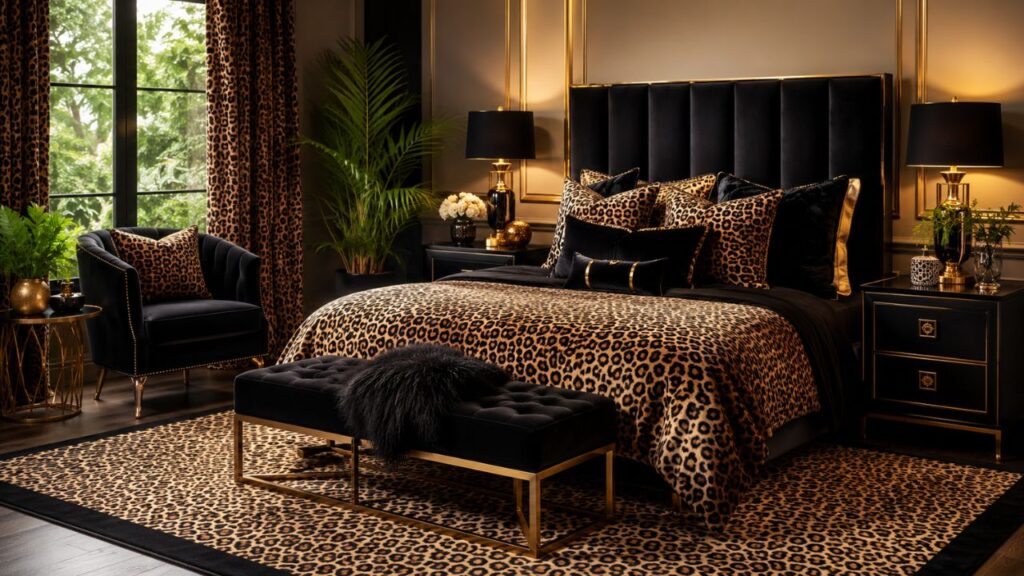
This is the part most guides skip, and it’s the part that actually determines whether your room looks intentional or accidental. Leopard print works best as an accent, not a background. Think of it the way you’d think of a bold lipstick — one strong element the rest of the room is built to support.
1. Bedding and Throw Pillows
This is the lowest-commitment, highest-impact entry point, and it’s where I start almost every client who’s nervous. A leopard print duvet cover or a couple of leopard print throw pillows against a solid, neutral base (white, cream, camel, charcoal) gives you the visual punch without covering four walls in it.
If you’re testing the waters, start here. You can swap it out in a season if it’s not for you, no drywall repair required.
2. An Accent Wall or Wallpaper
Once someone’s confident, this is usually the next move. A single leopard print wallpaper wall — typically the one behind the headboard — turns the bed into the focal point instead of fighting for attention against four saturated walls. Brands like Cole & Son and Schumacher have built entire reputations on their leopard print wallpaper collections, and for good reason: it’s genuinely one of the most requested archival patterns in the wallpaper world.
3. A Statement Rug
An area rug in leopard print grounds a room without overwhelming your sightline, since you’re looking down at it, not directly at eye level. It also tends to survive style changes longer than wallpaper does — if you get tired of the look, a rug is a lot easier to replace than a wall.
4. Curtains or Drapery
Leopard print curtains soften a room in a way wallpaper can’t, because fabric catches and diffuses light instead of reflecting it. This works especially well in a bedroom that already leans neutral and just needs one layer of texture and pattern near the window.
5. Furniture and Upholstery
This is the advanced-level move — a leopard print accent chair, an ottoman, or a headboard upholstered in a faux fur or velvet leopard fabric. It’s a bigger investment and a bigger commitment, so I usually only recommend it once a client has lived with smaller leopard print accents and knows they still love it six months later.
Comparison: Which Leopard Print Element Fits Your Situation
| Element | Commitment Level | Best For | Approximate Cost Range |
|---|---|---|---|
| Bedding & pillows | Low | Renters, first-timers, small budgets | $40–$250 |
| Area rug | Low–Medium | Adding warmth without covering walls | $80–$600 |
| Curtains | Medium | Softening a neutral room | $60–$300 per panel |
| Accent wall (wallpaper) | Medium–High | Homeowners, statement headboards | $150–$800 (materials + install) |
| Upholstered furniture | High | Design-confident clients, focal pieces | $300–$3,000+ |
Color Palettes That Make Leopard Print Look Expensive, Not Cheap
The single biggest factor in whether a leopard print bedroom reads as luxe or dated isn’t the print itself — it’s what you pair it with. I’ve seen the exact same leopard print duvet look like a boutique hotel in one room and a college dorm in another, purely because of the surrounding palette.
Pairings that work:
- Camel, cognac, and warm brown — this is the most classic combination and it’s classic for a reason. It leans into the print’s natural, earthy tones instead of fighting them.
- Black and cream — high contrast, graphic, and closer to a glam or Art Deco direction. This is the pairing Kelly Wearstler tends to favor.
- Blush pink — softens the print considerably and pulls it into a more feminine, romantic register.
- Deep emerald or forest green — an unexpected but genuinely striking combination that reads jungle-luxe rather than costume-y.
- Warm white and natural wood — the calmest option, good for people who want the print but not the drama.
Pairings that tend to backfire:
- Too many other patterns competing for attention — stripes, florals, and leopard in the same sightline usually reads chaotic rather than curated.
- Neon or overly saturated brights — these push the room toward “themed party” territory instead of “considered interior.”
- Cool undertones like icy blue or stark gray — leopard print is warm by nature, and cool-toned pairings can make it look artificial.
Matching Leopard Print to Your Existing Bedroom Style
You don’t need to gut your bedroom to introduce this print. Here’s how it slots into styles people are already working in.
Boho Bedrooms
Leopard print already has a natural home in bohemian interiors, alongside macramé, rattan, and warm wood tones. A leopard print throw over a woven bench or a leopard rug layered on top of a jute rug is a very “boho done right” move.
Glam and Maximalist Bedrooms
This is leopard print’s most obvious home. Velvet, brass, mirrored furniture, and a leopard print accent chair or headboard lean fully into old-Hollywood glamour. If you’re maximalist-curious, this is where the print does the most storytelling.
Modern Eclectic Bedrooms
Here, leopard print acts as the “warm” counterweight to clean lines and minimal furniture — a single leopard pillow on an otherwise architectural, neutral bed setup. It keeps a modern room from feeling sterile.
Coastal or Scandinavian Bedrooms
Trickier, but not impossible. Keep it to one small, muted accent — a leopard print in soft taupe tones rather than high-contrast black and gold — so it doesn’t clash with the airy, light-driven palette these styles are built on.
Small Bedroom vs. Large Bedroom: Different Rules Apply
A question I get constantly: “Will leopard print make my small bedroom feel cramped?”
Short answer: not if you use it correctly. In a small bedroom, I steer clients toward one concentrated moment — bedding or a single accent wall behind the headboard — rather than spreading it across multiple surfaces. Too many leopard print elements in a tight space competes for visual attention and can genuinely make a small room feel busier and smaller.
In a larger bedroom, you actually have more room to layer it — a leopard rug and a couple of throw pillows and a small accent chair — because there’s enough negative space (plain walls, solid bedding, open floor) to let each element breathe.
Real Example: How I Used This With an Actual Client
One project that sticks with me: a client in a 1920s Tudor-style home wanted her primary bedroom to feel “collected, not decorated.” Her starting point was a cream wool rug, white walls, and a walnut bed frame — nice, but flat.
We added a leopard print wallpaper on the wall behind the headboard, kept the bedding in warm ivory linen, and brought in one leopard print lumbar pillow to echo it. Brass sconces on either side of the bed picked up warm undertones from the print instead of fighting it. The rest of the room — curtains, rug, nightstands — stayed completely neutral.
The result didn’t read as “leopard print bedroom” the way a themed room might. It read as an intentional, expensive-feeling space that happened to have one bold pattern in it. That’s the goal, every time: the print supports the room, it doesn’t run the room.
Common Mistakes That Make Leopard Print Look Cheap
I’ll be blunt about this part because it’s the difference between a room that ages well and one you’ll want to redo in eighteen months.
- Using it everywhere at once. Walls, bedding, curtains, and a rug all in leopard print in the same room reads as costume, not decor.
- Choosing a print with an unnatural color base. Hot pink or neon leopard print tends to skew novelty rather than sophisticated. Stick to natural tonal ranges — golds, browns, blacks, creams — unless you’re deliberately going for a playful, maximalist statement.
- Ignoring texture. Flat, glossy leopard print fabric reads cheaper than something with texture — velvet, faux fur, boucle, or a slightly nubby cotton.
- Pairing it with low-quality materials elsewhere. Leopard print gets unfairly blamed for looking cheap when it’s actually the particle-board furniture around it doing the damage. Invest in solid materials nearby and the print itself looks far more expensive.
- Skipping the negative space. Leopard print needs breathing room. Solid-colored walls, simple furniture silhouettes, and plain flooring let the pattern do its job without visual noise competing against it.
Where to Shop: Brands Worth Knowing
You don’t need to build a custom furniture piece to pull this off. A few names consistently show up in leopard print home decor for good reason:
- Anthropologie — reliably strong for leopard print bedding, throw pillows, and accent furniture with a boho-glam lean.
- West Elm — good source for more understated, tonal leopard print rugs and throws.
- Cole & Son and Schumacher — the go-to names for high-end leopard print wallpaper.
- Etsy independent shops — worth checking for custom or made-to-order leopard print curtains and pillow covers if you want something that isn’t in every other bedroom on Pinterest.
- HomeGoods and TJ Maxx — genuinely underrated for one-off leopard print accent pieces at a fraction of designer pricing, if you’re patient enough to check in regularly.
DIY Options If You’re Not Ready to Buy
If you want to test the look before spending real money, a few low-risk options:
- Drape a leopard print throw blanket over the foot of the bed — zero commitment, full visual impact.
- Reupholster an old bench or ottoman cushion in leopard print fabric — a manageable weekend project even for a beginner.
- Frame a piece of leopard print fabric as wall art instead of committing to wallpaper.
- Swap just your pillowcases, not the whole duvet, for a smaller dose of pattern.
Lighting Matters More Than People Expect
Warm lighting is non-negotiable with this print. Cool-white LED bulbs (anything above 3000K) tend to flatten leopard print’s natural warmth and can make it look artificial or washed out. Stick to warm white bulbs (2700K–3000K), and where possible, layer your lighting — a bedside lamp, a wall sconce, maybe a dimmer on the overhead fixture — instead of relying on one harsh overhead source. The print genuinely looks different, and better, under warm, layered light.
Frequently Asked Questions
Is leopard print bedroom decor out of style in 2026? No — if anything, animal print has had a steady resurgence over the past few years as maximalist and “grandmillennial” design trends have grown more mainstream. The key isn’t whether the print itself is trendy; it’s whether it’s styled with intention and paired with quality materials.
Does leopard print work in a small bedroom? Yes, as long as you keep it to one concentrated element — bedding or a single accent wall — rather than layering it across multiple surfaces, which can make a tight space feel busier.
What colors go best with a leopard print bedroom? Camel, cognac, black, cream, blush pink, and deep emerald all pair naturally with leopard print’s warm tonal range. Cool blues and grays tend to clash with it.
Can leopard print work in a masculine bedroom? Absolutely — pair it with darker woods, charcoal or black bedding, and matte black or brass hardware for a moodier, more masculine take rather than the softer, glam version most people picture.
Is leopard print bedding good for hot sleepers? This depends more on fabric than pattern. Look for cotton or linen leopard print bedding rather than polyester or velvet if temperature regulation matters to you — the print itself doesn’t affect breathability, but the material does.
How do I keep a leopard print bedroom from looking dated? Avoid overly saturated, high-shine synthetic fabrics, keep the rest of the room’s materials high-quality, and use the print as one deliberate accent rather than an all-over theme.