Somewhere around 2019, “modern farmhouse” stopped being a design style and started being a punchline. Every rental flip had the same white shiplap wall, the same black-framed barn door, the same mason jar full of something. If you’ve been avoiding the style ever since because it felt played out, you’re not wrong about what it was. But you’re behind on what it’s become.
The style didn’t die. It got edited. And the version people are building and decorating now looks different enough from the 2018 peak that a lot of “modern farmhouse is dead” takes are actually arguing against a version of the style nobody’s doing anymore.
Here’s what’s actually true, what’s changed, and how to do this without it looking like a stock photo.
What Modern Farmhouse Actually Means Today
At its core, modern farmhouse pairs the massing and materials of a rural American house — pitched rooflines, board-and-batten siding, generous porches, apron-front sinks — with the open, clean-lined interiors of contemporary design. It’s the collision of two instincts: nostalgia for a simpler domestic image, and the practical wants of a modern household — big kitchens, open sightlines, low-maintenance surfaces.
What’s changed since the style’s 2016–2019 peak is saturation and restraint. The early version leaned hard into theme: shiplap on every wall, “Live Laugh Love” signage, distressed everything. The current version treats those as accents, not a mandate. Shiplap might show up on one wall, or not at all. The signage is gone. What’s left is the underlying logic — warm neutrals, natural texture, black metal accents, clean furniture — without the costume.
If there’s one sentence that separates 2026 modern farmhouse from the 2018 version, it’s this: the room should look like people live well in it, not like it’s performing a theme for guests.
The Five Sub-Styles Hiding Under One Name
Part of why “modern farmhouse” content online feels contradictory is that it’s not one style — it’s a family of five, and most guides never separate them. If you’ve felt like you’re getting conflicting advice, this is probably why.
Classic modern farmhouse. The baseline: white or off-white walls, natural wood tones, black hardware, shiplap or board-and-batten as an accent. This is the Joanna Gaines–associated look that popularized the category, though the wider trend has since developed well beyond any single designer’s aesthetic.
European farmhouse. Softer and more textural. Plaster-look walls instead of stark white, arched openings, warmer and more varied wood tones, less black-and-white contrast. This is where a lot of the style is trending as the classic version starts to feel dated.
Organic modern farmhouse. A crossover with Japandi and organic modern design — more curves, more natural fiber (rattan, jute, linen), less hard black-and-white contrast, warmer overall temperature.
Industrial farmhouse. Leans into raw materials — exposed brick, steel-framed windows, concrete — paired with farmhouse warmth in the textiles and wood. More common in converted or urban spaces than new builds.
Modern farmhouse ranch. The single-story, wider-footprint version, popular where lot sizes or accessibility needs favor one level. Same material language, different massing.
If a room or a house you’re referencing doesn’t quite match “classic” modern farmhouse, it’s very likely one of these adjacent variants — not a failure of the classic style, and not you doing it wrong.
Is Modern Farmhouse Going Out of Style in 2026?
Short answer: no, but the version that’s staying isn’t the version at its saturation peak.
Modern farmhouse plans accounted for roughly a third of all house plan sales in 2025, a share that held steady year over year and comfortably outsold every other individual style category. Search interest for the term has continued climbing rather than dropping, and the hashtag volume on social platforms is in the low millions of posts — this is not a niche or fading category in the way “farmhouse chic” was five years ago.
What’s actually declining is a specific execution: heavy shiplap saturation, stark all-white kitchens, and matched-set “farmhouse decor” (the mason jars and vintage-sign end of the spectrum). Designers surveyed in 2025 pointed toward earthier, more calming palettes replacing the all-white kitchen era specifically. That’s a maturation of the style, not a rejection of it.
For resale purposes, this matters: a farmhouse-style house (the architecture — the roofline, the massing, the porch) tends to hold its value better than farmhouse-style decor (the shiplap, the specific paint color), because architecture is expensive to change and buyers are shopping for it directly. If you’re building, the bones are the safe long-term bet. If you’re decorating a home you already own, treat the finishes as changeable and don’t over-invest in anything trend-specific and hard to reverse.
The Color Palette That Actually Works (And Why)
Most lists of “modern farmhouse paint colors” just hand you a swatch name with no context, which is close to useless — the same white reads completely differently in a north-facing room with cool light than it does in a south-facing room flooded with warm afternoon sun.
The two workhorse whites in this style are warm, not stark. Sherwin-Williams Alabaster and Benjamin Moore White Dove both carry a soft, warm undertone rather than a cool, blue-white cast — that warmth is what keeps a modern farmhouse room from tipping into sterile or clinical. Stark, cool whites are one of the fastest ways to accidentally land in “hospital” territory instead of “farmhouse.”
Build the rest of the palette around wood tone, not around the wall color in isolation. A lighter, toasted-oak floor pairs well with deeper, more saturated accent colors — a muted green, a warm gray-beige — because the light floor gives the room somewhere to rest visually. A darker walnut floor generally wants a lighter, airier wall and textile palette above it, or the room reads heavy and closes in on itself, especially in smaller spaces.
Greige — the warm gray-beige family — is doing a lot of work in the current palette as a bridge color: warmer than a true gray, more grounded than a true white, and forgiving of mixed lighting throughout a day.
The practical rule: pick your wood tone first, test your white in the room at three times of day, and treat any bold accent color as a single-surface commitment (an island, a door, a fireplace surround) rather than a whole-room bet.
Materials and Finishes That Read as Farmhouse — Not Rustic Cosplay
This is where most budget decorating attempts fall apart: buying farmhouse-labeled products instead of farmhouse-logic materials.
Siding and wall treatment. Board-and-batten is the most recognizable exterior signature, and it works as an interior accent wall too — but one wall, not four. Shiplap is not banned; it’s just no longer the default answer for every accent wall. If you use it, pair it with something that isn’t also wood-toned nearby, or the room starts to look like a cabin instead of a farmhouse.
Hardware. Matte black is still the classic pairing, but it’s worth knowing it can read flat or slightly cheap at scale, especially on budget hardware with thin plating. A cast iron or deeper, richer dark metal finish holds up better under close inspection and ages more gracefully than a thin matte black coating that can chip or wear shiny at contact points.
Roofing (exterior). Standing seam metal in dark gray, black, or galvanized finish is the current default for a reason — it reads clean and contemporary against the traditional roofline, where dark asphalt shingles read as the budget compromise they usually are.
Countertops and surfaces. Quartz has largely replaced the distressed-wood-and-marble mashup of the earlier era, because it delivers the clean-lined, low-maintenance surface that the “modern” half of the style actually promises.
The single biggest material mistake: buying reclaimed-look laminate or vinyl “wood” instead of committing to real wood or genuinely well-made wood-look materials in high-touch areas. It’s the difference a hand notices even when the eye initially misses it, and it’s usually the first thing that gives a “farmhouse” room away as a themed rental rather than a lived-in home.
Room-by-Room: Kitchen, Living Room, Primary Bath, Entry
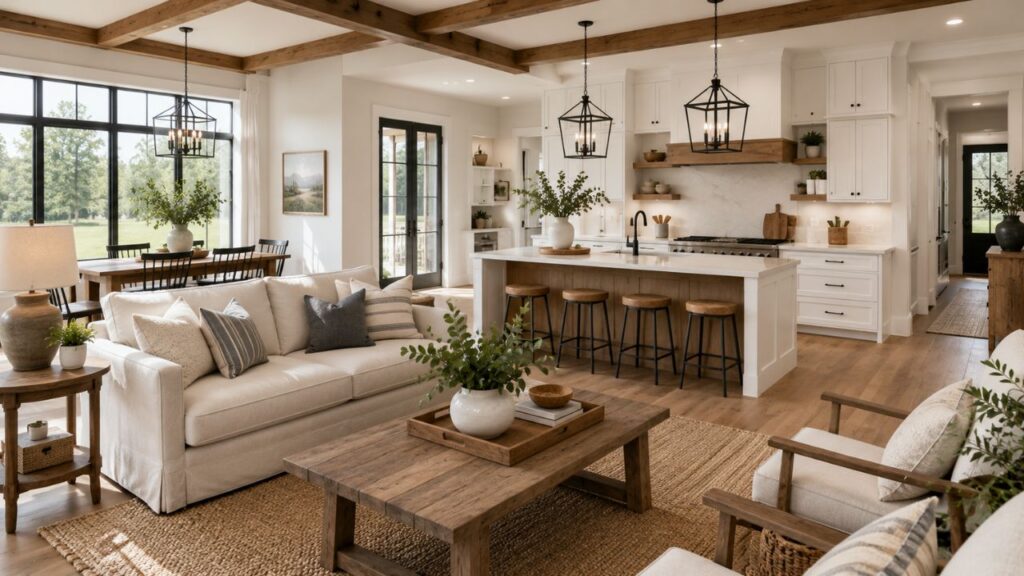
Kitchen. This is the room the style is judged by. The apron-front (farmhouse) sink is the single most recognized element — fireclay in white is the traditional choice, though darker fireclay and cast-iron versions are gaining ground as the all-white kitchen era cools off. Shaker-style cabinet doors, a mix of open shelving and closed storage (not all-open — that’s high-maintenance and rarely stays styled), and a single deep-toned accent, often on the island, are the current formula. Avoid pairing more than two statement elements in one kitchen — a farmhouse sink and an exposed-beam ceiling and a shiplap hood surround and patterned tile starts to look like a showroom, not a kitchen.
Living room. This is where the “less styled, more lived-in” mandate matters most. Clean-lined, comfortable upholstered furniture (not distressed or overtly “country” pieces) does the heavy lifting; farmhouse character comes through in a reclaimed or live-edge coffee table, linen textiles, and one or two natural-material accents — not in matching every surface to a theme.
Primary bath. Freestanding tubs, matte black or aged-brass fixtures, and a natural stone or large-format tile floor read modern farmhouse without needing a single “farmhouse” labeled product. This is the room where restraint pays off most, since bathrooms are small and over-styling shows immediately.
Entry / mudroom. The most function-forward room in the house, and where a lot of homes actually earn the “farmhouse” feel through built-in bench storage, hooks, and durable flooring rather than decor. It’s also the room designers most often flag as neglected — treated as an afterthought rather than styled with the same intent as the rest of the house.
Exterior & New Build: What Changes If You’re Building
If you’re building rather than decorating, the calculation shifts, because you’re locking in architecture rather than swapping finishes.
Roofline and massing. A steep roof pitch — commonly in the 8:12 to 12:12 range — combined with a gable-end orientation facing the street and a largely symmetric front facade is the defining shape of the style. A generous covered porch is close to mandatory; a modern farmhouse without one reads as an incomplete version of the style, no matter how correct the siding and paint are.
Window grilles. This is a small detail that disproportionately affects how “correct” the house reads. Divided-light grilles on the front-facing windows only is the signature look. Grilles on every window pushes the house toward traditional; grilles on none pushes it toward flatly modern. Getting this one detail wrong is a common reason a build looks slightly off without the owner being able to say why.
Climate adaptation. A dark standing-seam roof looks sharp in photos, but in a hot, high-sun climate it’s a real cooling-cost consideration; a deep, generous porch is a genuine asset in that same climate and a snow-load consideration in a cold one. The style’s defaults were largely set by builders in temperate and warm regions — adapt the specifics (roof color, porch depth and orientation, window sizing) to your actual climate rather than copying a photo from a different region wholesale.
Where the budget actually goes. Steep roofs, dormers, and vaulted ceilings are the three most common places a modern farmhouse build quietly exceeds a standard construction budget, because each adds framing complexity and material beyond a simpler roofline or flat ceiling. If you’re pricing a build against a generic per-square-foot number, budget extra specifically for these three items rather than assuming a flat rate covers them.
What It Costs (2026 Ranges, Broken Down)
Costs vary enormously by region and finish level, but the ranges that keep showing up across current builder and cost-estimator data give a workable baseline.
- Overall cost per square foot: roughly $80–$200 per square foot for a modern farmhouse build, depending on region, finish level, and site conditions. A 2,000-square-foot house lands very roughly in the $160,000–$400,000 range on construction alone before land.
- Land: commonly $3,000–$10,000 per acre depending on the market, plus $1,500–$3,000 in site preparation before construction even starts.
- Foundation: typically $4,500–$15,000+ depending on soil conditions and foundation type (slab, crawl space, or basement).
- Framing and structural work: commonly $20,000–$50,000+, and this is one of the categories most affected by the style’s steep rooflines and dormers specifically.
- Exterior finishes (siding, roofing, trim): roughly $10,000–$40,000 depending on material choices — this is where standing-seam metal roofing and real board-and-batten siding cost meaningfully more than the vinyl and asphalt-shingle budget alternatives, but also where the style’s visual signature lives, so it’s the category worth protecting in a tight budget rather than the first place to cut.
- Timeline: an 8-to-12-month construction window is a realistic estimate for a custom modern farmhouse build, longer than a standard production home, largely because specialty materials like real wood siding, custom windows, and artisan hardware carry longer lead times than stock builder-grade equivalents.
For a renovation rather than new build, room-level costs vary too widely to generalize responsibly — a farmhouse kitchen remodel, for instance, can range from a few thousand dollars in a cosmetic refresh (paint, hardware, a new faucet) to well into six figures for a full gut renovation with custom cabinetry and structural changes. Treat any single national “farmhouse kitchen cost” figure with real skepticism; get a local quote against your actual scope.
Mistakes That Make Modern Farmhouse Look Cheap or Dated
Over-styling with theme decor. Filling every surface with visibly “farmhouse” objects — signage, faux farm tools, an excess of mason jars — is the single fastest way to make a room read as themed rather than designed. The current version of the style is defined by restraint; if a stranger could identify the style from three feet away without seeing the architecture, it’s probably over-styled.
Overcorrecting into stark white. In reaction against the “too rustic” criticism, some rooms swing too far the other way into cold, stark white with no warmth — which reads as generic contemporary, not farmhouse, and loses the cozy quality that made the style appealing in the first place.
Mismatched hardware finishes across one space. Matte black cabinet pulls next to a brushed-nickel faucet next to a bronze light fixture in the same kitchen is one of the most common and most visible inconsistencies in DIY attempts. Pick one dark metal finish family and hold it across fixtures, hardware, and lighting in a given room.
Cheap roofing choices on a build. Asphalt shingles undercut the architectural signature of the style more than almost any other single decision. If the budget is tight, it’s worth prioritizing standing-seam metal on at least the front primary gable, even if a cheaper material covers less visible roof planes.
Generic builder-grade finishes. Stock vinyl windows, a generic carriage-style garage door, and big-box pendant lighting are the details that quietly flatten a build from “modern farmhouse” to “generic new construction with white siding.” The style depends on specificity in these smaller decisions, not just the big architectural moves.
Ignoring climate context. Copying a photo from a different climate zone wholesale — a dark roof in a hot, high-sun region, or a home with no snow-shedding consideration in a cold one — creates real functional problems, not just aesthetic ones.
FAQ
Is modern farmhouse going out of style in 2026? No — the architecture and house-plan category remain strong, but the decor execution is maturing away from heavy shiplap and stark all-white kitchens toward warmer, more textural palettes.
What’s the difference between farmhouse and modern farmhouse? Traditional farmhouse leans into rustic, often distressed or heavily “country” detailing and smaller, compartmentalized rooms. Modern farmhouse pairs the same architectural bones — pitched roofs, porches, board-and-batten — with clean-lined, open, contemporary interiors and restrained styling.
What colors are used in modern farmhouse design? Warm whites (not stark or cool-toned), greige, and warm neutral wood tones form the base palette, with a single deeper accent color — often a muted green or gray-beige — used sparingly rather than throughout.
How much does it cost to build a modern farmhouse? Roughly $80–$200 per square foot for construction, varying widely by region, finish level, and site conditions, with steep rooflines, dormers, and vaulted ceilings as the categories most likely to push a budget above a generic estimate.
What makes a kitchen “modern farmhouse” instead of just “farmhouse”? An apron-front sink and shaker cabinetry provide the farmhouse reference point, while clean lines, quartz surfaces, and restrained styling (rather than heavy distressing or dense decor) supply the “modern” half.
Is shiplap still in style? Yes, but as a restrained accent — typically one wall — rather than the default treatment for every accent surface, which was the dominant approach during the style’s earlier saturation period.